Universal Audio Volt Gen 2 and Max: Did They Just Kill Entry-Level Audio Interfaces? (And Why They Cost Less Than the Apollo)


If you thought the sub-£300 audio interface market was dead, Universal Audio just dropped a bombshell.
The new Volt Gen 2 (G2) and Volt Max aren't just a cosmetic makeover to sell a few more boxes at Christmas. They're machines that raise the bar for quality so high that they'll make longtime competitors tremble.
32-bit converters, 127 dB of dynamic range, onboard DSP, ADAT input and UAD Console integration.
Stuff that until yesterday you could only find on interfaces that cost three times as much.
No more forum chatter. Let's see exactly what they've done, what the real differences are from the previous series, and, above all, I'll answer the uncomfortable question you're all asking: "But at this point, why should I spend thousands of euros on an Apollo?"
The real revolution: Internal DSP and the new Preamps
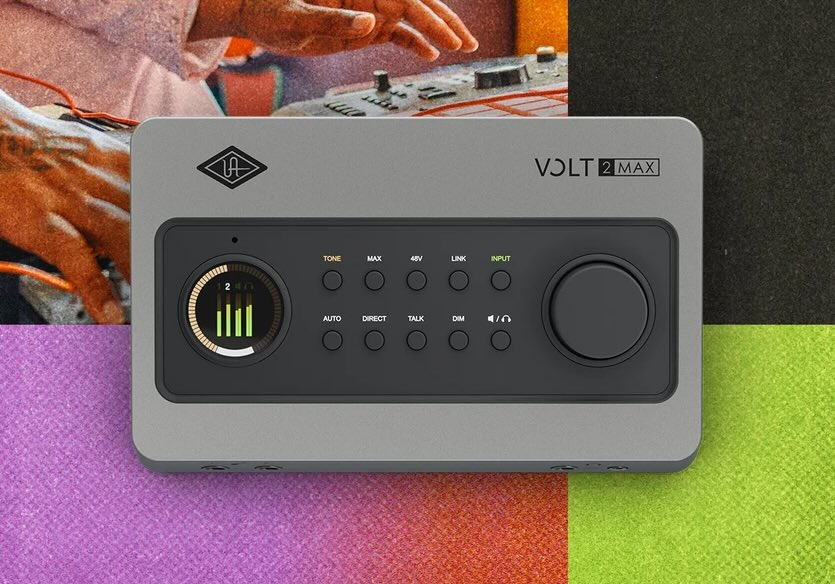
The huge difference between these Gen 2s and the old Volts is under the hood. Universal Audio has abandoned the static analog circuitry and incorporated a full-fledged internal DSP to manage the preamps.
The new preamps offer 60 dB of ultra-clean gain (ideal for hungry mics) and tone shaping. Right from the onboard button (or from the UAD Console on your computer), you can apply three historic preamp characteristics to your signal as you record:
US Tube: Adds thickness, warmth and body by saturating the lows.
US Solid State: More cleanliness and granite presence.
British Class A: The classic bright aggression of English consoles to make the vocal cut through the mix.
In the Volt Max versions, the situation literally gets out of hand.

In addition to these three preamps enriched with harmonic saturation, the DSP also manages Max Processing : 6 surgical presets (for vocals, bass, and guitars) that chain together perfect emulations of the LA-2A, 1176 compressors, and discrete VCAs. Record your vocals and they're already squashed, focused, and ready to go, without touching a plugin in your DAW.

Converters, Displays, and UAD Console
Until recently, the major limitation of the Volts was not having the flexible routing software of the Apollos. Now, all Gen 2 and Max models integrate seamlessly into the UAD Console and Luna.
You can manage Loopback for streaming, headphone cues and presets directly from your computer.

The converters operate at 32-bit/192 kHz. The larger versions offer up to 127 dB of dynamic range.
And on the Max models (from the Volt 2 Max onward), Universal Audio has added an ADAT optical input to expand the inputs, a color Smart Display for metering, speaker switching outputs, and—obviously—a built-in front-panel talkback microphone with auto-dim for monitors. Pure madness for this price range.

UNIVERSAL AUDIO VOLT GEN2 AT THE BEST PRICE:
The Ruthless Comparison: Volt Max vs. Apollo
With specs like that, it's fair to ask: does it still make sense to spend money on an Apollo? The answer is absolutely yes, if you're a professional or mixing. Here are the undeniable differences:
Unison Technology: The Volts use DSP to print a color during recording. On the Apollos, Unison technology physically modifies the impedance of the hardware preamp before conversion, 100% replicating the electrical behavior of the original machine (Neve, API, SSL).
DSP for mixing: In the Volts, the DSP is only used for recording presets and can't be used for mixing. In the Apollos, the UAD-2 processor processes the UAD suite's incredibly demanding plug-ins directly in the hardware during mixing, eliminating the load on your computer's CPU.
Ultimate Routing and I/O: Apollo's UAD Console is a complete virtual mixer with infinitely customizable sends, auxiliary buses, and plugin chains at absolutely zero latency. This is vital if you have a real studio and need to record an entire band while providing separate auditions for each musician.
In short: the Volt Max is the ultimate machine for the home studio producer, singer, and beatmaker who wants the massive power of Universal Audio without the hassle of plug-ins. The Apollo remains the unrivaled standard for control rooms that need to manage complex workflows and hybrid chains.

FAQ: Frequently Asked Questions about the UA Volt Gen 2
To clear up any doubts about the technical details and understand which model is right for you, here are the answers to the most frequently asked questions.
Can I use standard UAD plugins inside Volt Gen 2?
Volt Gen 2 interfaces include DSP only for tone shaping and Max Processing presets (LA-2A, 1176, etc.) that are active during recording. You can't use their DSP to load traditional UAD plugins into your mix or onto the master bus. That feature remains exclusive to Apollo interfaces.
In any case, you can use UAD plugins in native mode (UADx) by relying on your computer's CPU (I've always used them this way, and with an M1 Mac they work great without weighing down the system).
What's the difference between the Volt G2 and the Volt Max?
The Volt G2 (Volt 1, 2, and 4) are compact, horizontal interfaces that offer Tone Shaping preamps (Tube, Solid State, British) and 32-bit converters. The Volt Max versions (Volt 2 Max, 4 Max, and 4P Max) are desktop-sized and add Max Processing (extra compression and limiting), a built-in talkback microphone, ADAT optical inputs, and an extra USB-C output that acts as a hub.
Do the Volt Gen 2s work with iPad or iPhone?
Absolutely. They are class-compliant and communicate directly with iOS devices via USB-C cable. The larger versions have a separate 5V power input to avoid draining the iPad's battery.
Do they have loopback for streaming?
Yes, all versions of the Volt Gen 2 and Max feature native loopback channels, conveniently managed from the UAD Console or Luna. You can sample your computer's internal audio or route it for live broadcasts on Twitch and YouTube without crashing or using cumbersome virtual cables.
What if I wanted something more Analog?
The DSP in the new Volts works wonders, but let's remember that we're still talking about digital emulations. If you're looking for the real weight of electricity, the three-dimensionality of physical transformers, and truly air-moving saturation, you need to turn to dedicated hardware machines. A perfect example is the Harrison FleX-10: a module that literally puts the preamps and filters of a real analog console in your hands. If you want to hear the raw difference in transients, watch my video or read the dedicated article on the Harrison FleX-10 here .

The final step: Mastering with real hardware machines
You’ve recorded flawless 32-bit tracks, crushed vocals with your new Volt’s built-in 1176 emulations, and locked in a flawless in-box mix.
Yet you notice that the explosive volume and three-dimensional density typical of international records are still missing. The DSP works miracles, but it doesn't move air.
When you entrust your songs to VDSS Studio 's Online Mastering or Stem Mastering services, we take your tracks and run real electricity through them. We physically sum your stems in the Neve 8816 summing mixer and add the ferocious punch of our custom Vari-Mu compressor .
Finally, we re-enter digital surgically through the merciless analog conversion of the Burl B2s .
Stop sounding fake and make your mixes explode.


Comments