The Best Audio Interfaces Under €150 (An Honest, No-Nonsense Guide)


Everyone asks me all the time: "Filippo, I have a budget of 150 euros, which sound card should I buy to start with or for my travel setup?"
The harsh truth is that in this price range the market is saturated with plastic toys with preamps that blow like the wind and drivers that crash every now and then.
However, if you know exactly where to look, there are machines that allow you to record definitive tracks, ready to end up on a record, without spending a fortune.
No more forum chatter, let's get straight to the point. Here are the three best sound cards under €150 that I recommend you put on your desktop.
1. Audient iD4 MKII : HD converters and British sound

If your primary goal is the highest possible audio quality and the most transparent conversion in this price range, the discussion begins and ends here. Audient has made a brilliant move: they've taken the exact same Class A mic preamp they use on their massive analog studio consoles and stuffed it into this little metal box.
Strong point: The JFET Instrument (DI) input on the front panel. If you're recording bass or electric guitar live and then using the virtual amps, this input adds a warmth and harmonic saturation that the typical Hi-Z inputs on budget cards can only dream of.
The Bare and Raw Specs:
Preamp: 1 Class A mic pre (58 dB gain, very clean) + 1 JFET DI input.
Converters: Monstrous dynamic range (120 dB ADC input, 125.5 dB DAC output). 24-bit/96kHz.
Output: Dual headphone outputs (large and small jack) capable of driving even high impedance headphones.
Software & Routing (iD Mixer): Audient's control application is incredibly simple yet deadly. It lets you manage audio loopback routing in an ultra-intuitive way: you can capture audio from your computer (e.g., from YouTube, Zoom, or Spotify) and send it back to your DAW, mixing it with your microphone. Perfect for podcasts and streams.
Compatibility: macOS, Windows, and iOS (iPad and iPhone). Being class compliant , it connects directly to Apple tablets via USB-C port without any problems.

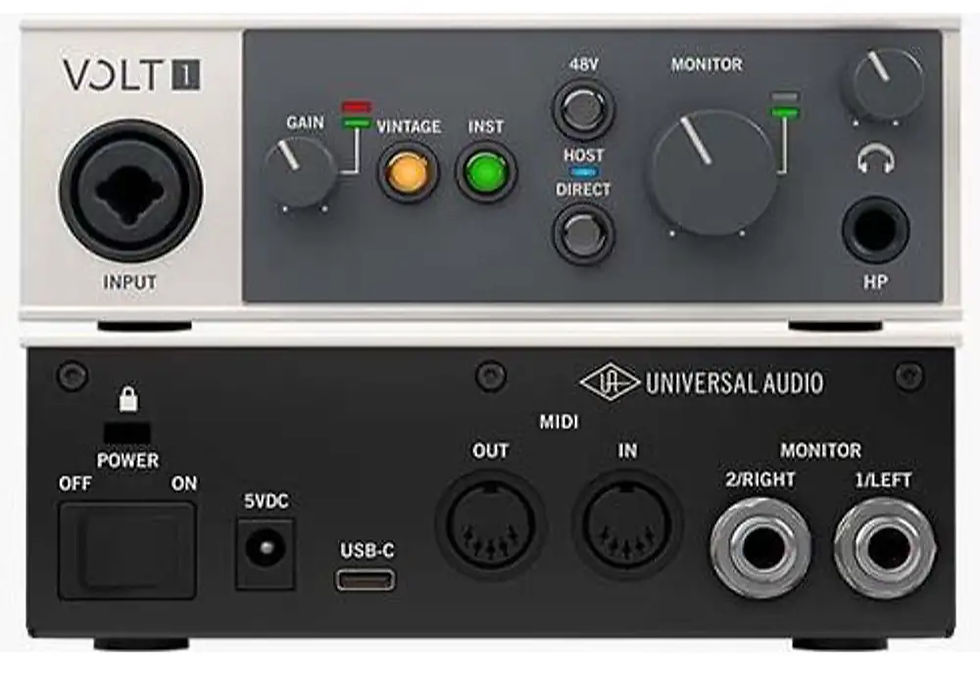
2. Universal Audio Volt 1 : The "In The Box" Character

Universal Audio is famous for its multi-million dollar Apollo interfaces, but with the Volt series, they've intelligently attacked the entry-level market. Instead of focusing solely on extreme clarity, they've focused on analog color.
Highlight: The magical "Vintage" button. Pressing it activates a 100% analog emulation (based on a real internal circuit, not a digital plugin!) of the legendary UA 610 tube preamp. It instantly adds those even and odd harmonics to give vocals and acoustic guitars presence and punch before you even open your DAW.
The Bare and Raw Specs:
Preamp: 1 Combo input (Mic/Line/Inst) with 55 dB of gain.
Converters: 24-bit/192kHz.
Extra connectivity: It has 5-pin MIDI In/Out ports on the back. If you have hardware synths, vintage drum machines, or old keyboards, this feature alone is worth the purchase (it's missing from both the iD4 and the Scarlett Solo).
Software & Bundle (UA Connect): Routing-wise, the Volt is plug-and-play and doesn't have a complex virtual mixer. But using the UA Connect app unlocks a software bundle unrivaled in this price range: UA compressors, Lexicon reverbs, Melodyne Essential, and Marshall and Ampeg amps.
Compatibility: macOS, Windows, and iOS/iPadOS. Works great on mobile devices and has a separate 5V power input, which is handy if your iPad is running low on battery.
3. Focusrite Scarlett Solo (4th Gen) : Reliability and Precision

We couldn't not mention it. Scarletts are standard interfaces for a reason: they always work, have rock-solid drivers, and ridiculous latency. The 4th Gen, however, has made a huge leap forward compared to previous versions.
Strong point: The completely redesigned "Air" function. It's now more than just a simple high-end EQ, but has two stages: "Air Presence" and "Air Harmonic Drive," a true DSP-driven harmonic saturation that pushes the vocal forward, making it cut through the mix.
The Bare and Raw Specs:
Preamp: The new preamps offer a whopping 57 dB of gain. Finally, you can plug in a hungry dynamic mic (like a Shure SM7B) without having to buy a Cloudlifter.
Converters: They use RedNet converters (the ones found in Focusrite machines costing thousands of euros) which guarantee a full 120 dB of dynamic range in AD/DA conversion. 24-bit/192kHz.
Software & Routing (Focusrite Control 2): A rewritten from scratch, lightweight, and incredibly stable app. From here, you can set sample rates and, most importantly, manage the two dedicated virtual Loopback channels. You can sample from the web or stream to Twitch with rock-solid stability.
Compatibility: macOS, Windows, and iPad Pro (USB-C). On Windows, Focusrite ASIO drivers have historically been among the most stable in the entry-level range.

FAQ: Frequently asked questions about entry-level sound cards
To clear up any doubts (and dispel some forum myths), here are the answers to the questions I get most often about this price range.
Can I produce and mix a professional album with a €150 sound card?
Absolutely. The AD/DA converters found today on machines like the Audient or the Scarlett 4th Gen have superior technical specifications to those found in the mega-studios of the '90s that recorded historic records. If your mix sucks, it's your untreated room, your listening habits, or your ears that are to blame. Let's stop blaming cheap gear.
Do I need to buy an external tube preamp to go with it?
No. Buying a €100 board and plugging in a €50 tube preamp is the best way to add nothing but background noise and mud to your signal. The built-in preamps on these three boards are spotless and offer enough gain (55 to 58 dB) to handle almost any microphone on the market. Use those.
Does the connection type (USB 2.0, USB-C, Thunderbolt) change the sound quality?
False. The data protocol doesn't change the sound of the card in any way. It only transfers zeros and ones. All these cards use USB-C connectors but operate over the USB 2.0 protocol: for handling two input channels in a low-latency home studio, this data rate is mathematically perfect.
How do I handle latency when recording voice if I don't have a super-fast computer?
All of these interfaces feature a "Direct Monitor" function (or the Mix knob on the iD4). Enabling it sends your microphone's audio directly to your headphones, physically, before it even enters your DAW. The result? Absolutely zero-latency listening, even if you're working on a massive project with your computer's 1024-bit buffer size.
The final step: The actual mastering
There is no such thing as the perfect sound card, but there is one that is perfect for your workflow.
Want surgical conversion, dual headphone outputs, and a monster DI? Get the Audient.
Want to print analog characters in recording and need MIDI? Go with Volt.
Need loopback, rock-solid drivers, and 57 dB of gain? The Scarlett won't let you down.
Once you've recorded your tracks cleanly with one of these machines, and after you've finished the in-the-box mix to perfection, the moment of truth arrives.
Digital and entry-level converters do an excellent job for production, but the weight, the glue, and the final three-dimensionality of a mastered track requires real electricity.
When you entrust your tracks to VDSS Studio 's Online Mastering or Stem Mastering services, we take your home-recorded tracks and get them out of the box.
We add them together in our Neve 8816 , add 3D glue with our custom Vari-Mu , and, if needed, print the master onto our MCI JH24 24-track tape recorder. We then recapture every single detail through the analog majesty of Burl B2 converters.
Turn your great recording into a real record.


Comments