The Secret of the English Sound: A Guide to the Diode Bridge Compressor


Open any blog or watch any YouTube tutorial and they'll always tell you the same thing: "Use a FET for attack, an Opto for smoothness, and a VCA to glue the mix together."
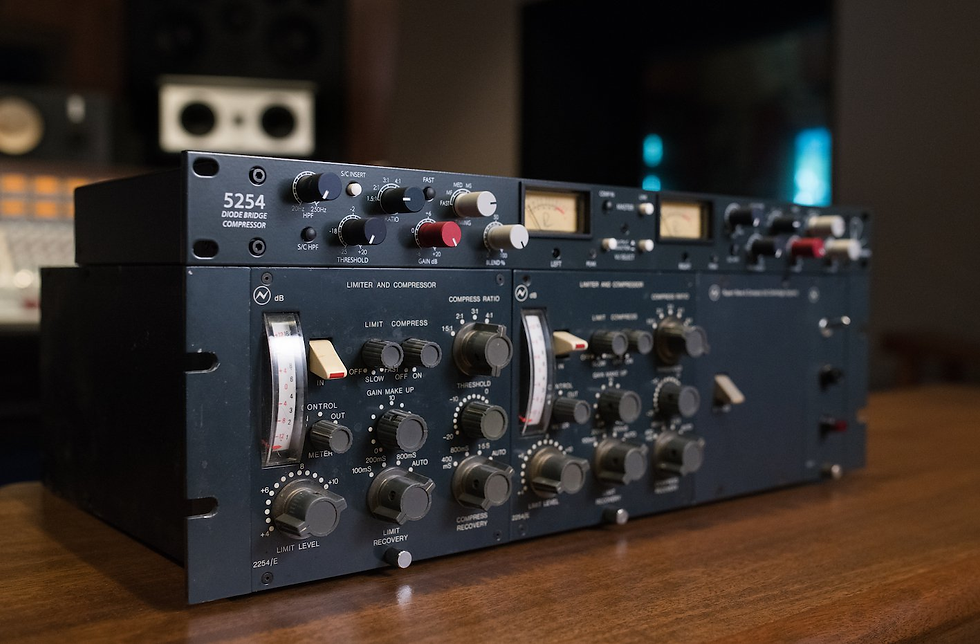
All well and good, but there's a huge elephant in the room. We're ignoring the circuit that for decades has pumped, swelled, and glued together the most famous rock and pop records in history: the diode bridge compressor .
If you've ever wondered how the mixes of great English engineers sound so thick, dense, and aggressive without sounding broken, the answer lies right behind these components. Forget the clinical transparency of modern VCAs: this is pure character.
The Mistake That Became Legend
The history of the diode bridge is fascinating because it was born from an engineering compromise.
In the 1960s, pioneers like Rupert Neve (who was designing for EMI studios and the BBC) were looking for a way to control signal dynamics. Diodes were inexpensive components and could vary their resistance based on the applied voltage, making them perfect for compressing audio.
There was just one problem: diodes, by their nature, generate a monstrous amount of harmonic distortion .
To make them work without completely destroying the signal, engineers had to dramatically lower the audio level before entering the diode bridge, then violently re-amplify it at the output, using huge transformers and line amplifiers.
The result? Legendary machines like the Neve 2254 and, later, the Neve 33609 .
Compressors that not only kept dynamics at bay, but "colored" the sound, adding a density and warmth (THD) that sound engineers all over the world began to love madly.

Why It Sounds That Way and When to Use It
The diode bridge isn't a scalpel, it's a velvet hammer. Unlike a VCA compressor (snappy, surgical, clean) or an Opto like the LA-2A (slow and transparent), the diode bridge is colorful and overbearing .
The more you push it, the more musically the circuit saturates.
Here's where it absolutely shines within a mix:
The Drum Bus: It's the death of it. Put a 33609 emulation on the drum kit, set it to a fast release (or Auto ) and a medium attack. The snare will take on an impressive physical thickness, and the cymbals will sit in the mix with a three-dimensional texture, without ever sounding sharp.
The Master Bus: Used in very low doses (no more than 1.5 or 2 dB of gain reduction), it provides that analog "glue" (the famous glue ) and saturation that make the song seem like a finished record ready for the radio, fattening up the low-end in a natural way.
Electric Guitars and Basses: When a track sounds too "digital" or thin, running it through a diode bridge instantly restores even and odd harmonics, placing it firmly in the listener's face.
The Best Plugins to Emulate It (Free & Paid)
Today, the in-the-box market offers us sensational options for getting this sound without having to mortgage our house to buy the original hardware.
The Best Ever (FREE):
Analog Obsession Britpressor : It's no secret that Analog Obsession's interfaces and algorithms are often superior to plugins costing hundreds of dollars. Britpressor is an absolute masterpiece. It's a hybrid that combines the power of the 2254 with the versatility of the 33609, and even includes a built-in EQ on the internal side-chain. If you don't have it in your plugin folder yet, stop and download it right now. It's a must-have.
Best Paid Options:
Arturia Comp DIODE-609 : A modern and visually stunning emulation of the 33609. Arturia has done a surgical job on the transformer saturation and added modern features such as Mid/Side and Advanced Sidechain.
UAD Neve 33609 : If you have Universal Audio DSP hardware, this is the industry standard. Certified emulation, gigantic sound, zero compromises.
Lindell 254 (Plugin Alliance) : If you're looking for the exact same rough, slow, and ultra-dense sound as the very first 2254, this plugin delivers. Slow, unrelenting, and incredibly colorful.
The Last Step: Real Iron
Plugins today do an incredible job of emulating the behavior of the diode bridge, but when it comes to packaging an entire song, the non-linear saturation of dozens of fake plugins risks accumulating masking and taking away three-dimensionality.
To really get the sound of the big English consoles, the electrons can't stay confined in the computer: they have to pass through copper, steel and transformers.
At VDSS Studio we take your mixes to another planet with our Online Mastering and Stem Mastering services.
We take your track groups and literally blow them up by running them through our Neve 8816 analog summing mixer. We recover incredible headroom, physically widen the stereo image, and capture the final mix with the Burl B2 's mastering-grade conversion, leveraging its transformers to deliver unmatched punch, texture, and density in the box.
Stop playing fake.


Comments